
Joy at Work
Here's What We Keep Getting Wrong.


A few years ago, the Democratic National Convention did something unexpected: it threw a party. The year Kamala Harris was nominated, the whole event felt less like a political convention and more like a communal exhale, exactly what the country needed. The roll call alone was a tour through America’s regional soundtracks. And when the Georgia delegation stepped up? One Lil’ Jon anthem later and I was fully out of my seat. But what stuck with me most was the recurring theme song, Joy, Unspeakable by Voices of Fire and Pharrell. For those who missed it, here’s a few bars…
It begins with the choir just chanting joy, joy, joy, joy, joy, joy, joy, joy…
Unspeakable speakable
The meaning's unreachable
I'll go where he leads me to
More synonyms, I'm gon need a few
You get the point. But the hook on commercials was the phrase joy, joy, joy. For a campaign built on good vibes, they rode that thing until the wheels finally came off. Now, this isn’t a political piece, but there's something worth borrowing from that campaign: the idea that joy isn't just a nice feeling. It's an organizing principle: one that most organizations have completely abandoned.
Red Threads
There’s a growing body of research that suggests that joy plays a larger role in how we experience our work (either for the better when it’s present) or for the worse when it’s absent. Just yesterday I found myself in back-to-back meetings doing the thing I love most: facilitating conversations. Different contexts, same activity, and the same feeling of being completely alive in the work.
It’s what Marcus Buckingham describes as red thread moments in his book Love + Work. It’s those magical moments where you find yourself not only doing work that matters, but your entire neurobiology lights up because the work sits at the exact intersection of what you're good at and what you genuinely care about.
He writes: The real key to success and satisfaction in life is identifying which activities you are drawn to over and over again.
Here’s a quick way to start finding yours. Ask yourself:
When was the last time you lost track of time at work?
When did you volunteer for something before anyone asked?
When did someone have to tear you away from what you were doing?
When did you surprise yourself with how well you performed?
When were you so locked in you didn’t want it to end?
Pay attention to the patterns in your answers. They’re pointing somewhere.
The Missing Ingredient
Knowing what lights you up is step one; reverse-engineering your work around it is a different challenge entirely. For that, I’ve been sitting with Kate Bowler’s recent book, Joyful Anyway. (Full disclosure: I’m only three quarters done through the book, so what follows is a working hypothesis, not a final verdict).
I took a picture of this framework earlier today:
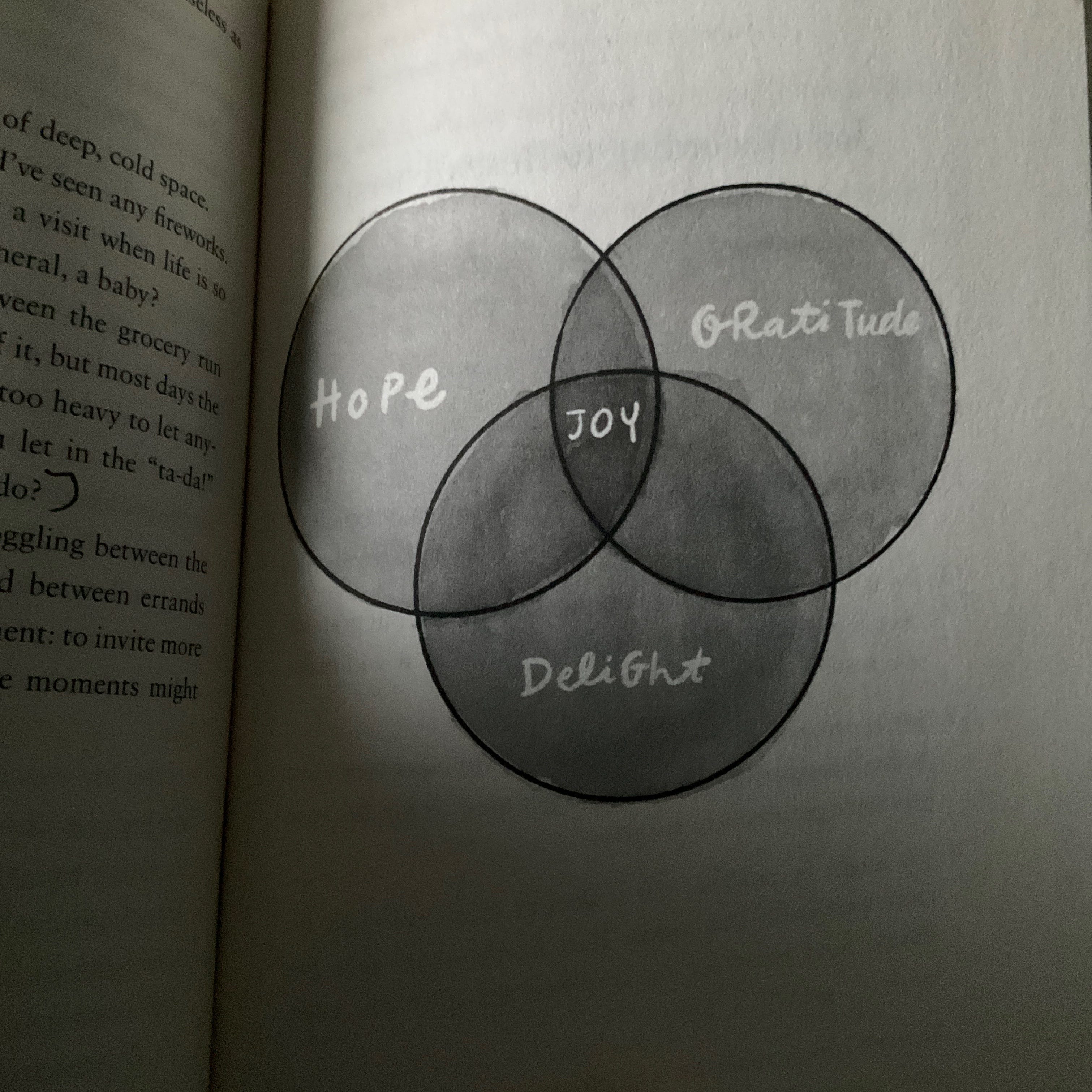
What surprised me was the word hope, because that always feels like the missing element in the joy equation. When work starts to feel like a grind, it's rarely because the tasks changed. It's because somewhere along the way, we lost the plot. The inspiring reason we started this company, this initiative, or this career move gets buried under the weight of daily execution. We're so consumed by the "to-do" that we miss every "ta-da."
That's the quiet cost of joyless work. It’s not one dramatic breakdown, but a slow accumulation of days where nothing feels meaningful and everything feels overwhelming. Until one day you look up and wonder why you're doing any of it.
Why This Matters Now More Than Ever
Joy isn't a luxury. It's jet fuel. We need it to keep going when the work is hard, the resources are thin, and the progress is slow. This is especially true for people doing work that requires a high degree of emotional labor (I’m looking at you teachers, social workers, nonprofit leaders, people on the front lines of serving others).
But here’s where most organizations get it wrong: they confuse joy with happiness.
Happiness is a perk. It’s the catered lunch, the flexible Fridays, the end-of-year bonus. And look, none of those things are bad. But they’re not joy. Happiness responds to good conditions. Joy sustains you despite difficult ones.
When organizations optimize for happy employees, they’re solving the wrong problem. The real question isn’t how do we make people feel good at work? It’s how do we create the conditions where people find joy in their work? Those are not the same questions, and the gap between them is where burnout lives.
Joy reminds us why the work matters. It generates moments that reconnect us to purpose, the kind that no ping pong table can replicate. It creates the hope that keeps us moving forward even when the results aren’t there yet.
We’re collectively responsible for building those conditions. And in this moment with disengagement at historic levels and people quietly quitting their way through the week, we need to get serious about creating it.